
Quick Answer
Recruitment process outsourcing (RPO) is when an employer transfers all or part of its recruitment process to an external provider that takes ownership of designing and running it — and responsibility for the results. That's the difference from a staffing agency, which responds to individual job orders.
RPO also stands for Recovery Point Objective in IT and Run-Pass Option in American football — this article is about recruitment.
Try to get a straight answer on recruitment process outsourcing and you'll notice something about the pages you land on. Almost all of them are written by companies selling it.
That's not a criticism — RPO providers know the model better than anyone. But it does mean the comparison you actually want (RPO or a staffing agency or another internal recruiter?) is hard to find written by someone who doesn't sell one of the options.
This guide is for two readers. If you're an HR or operations leader, it lays out what RPO is, how it's priced, and when it beats the alternatives. If you run a staffing agency, the last section covers what changes when you add an RPO desk — because a lot of agencies are thinking about exactly that.
TL;DR — Key Takeaways
| Question | Short answer |
|---|---|
| What is RPO? | An outsourced provider owns and runs all or part of your recruitment process |
| How's it different from an agency? | Agencies fill job orders; RPOs own the process and the results |
| What does it cost? | Cost per hire, management fee, or FTE-based — no public rate cards |
| How big is the market? | About $8bn in global buyer spend (SIA, 2023 data) |
| Who are the big providers? | Korn Ferry, Cielo, Randstad Sourceright, AMS, PeopleScout, WilsonHCG, Hudson RPO |
| Can a staffing agency run RPO? | Yes — and many are adding it as a service line |
What Recruitment Process Outsourcing Actually Means
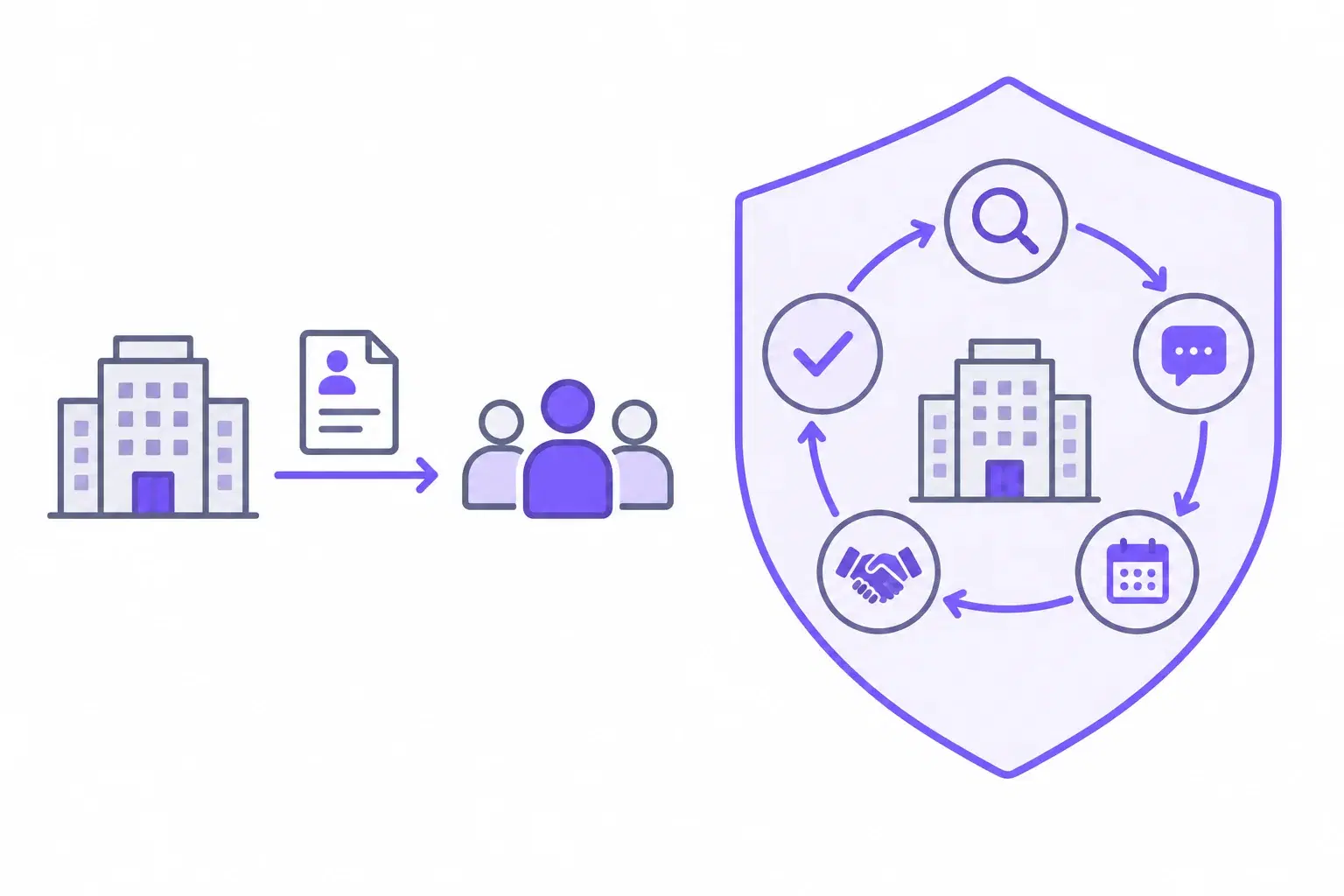
The cleanest definition comes from the industry's own trade body. The Recruitment Process Outsourcing Association describes RPO as "a form of business process outsourcing (BPO) where an employer transfers all or part of its recruitment processes to an external service provider." The provider can bring its own staff, technology and reporting, or take over the employer's.
The One-Line Difference
In the RPO Association's words, RPO "differs greatly from providers such as staffing companies and contingent/retained search providers in that it assumes ownership of the design and management of the recruitment process and the responsibility for results."
RPO Association, "What is Recruitment Process Outsourcing (RPO)?", last revised February 2024.
Read that sentence twice, because everything else in this article follows from it. Ownership is the whole idea.
A staffing agency gets a job order and works it. It doesn't decide how your interviews are structured, how fast hiring managers give feedback, or what your careers page says. An RPO does — or at least shares that decision with you, under a contract that measures it on the outcome. That single difference explains the different pricing, the longer contracts, and why the two models so often sit side by side at the same client.
What an RPO typically takes over
Scope varies by contract, but a full engagement can include:
- Employer brand and job advertising — writing and placing roles, usually in the client's name, not the provider's
- Sourcing and screening — building pipelines, running first-stage screens, managing assessments
- Interview scheduling and coordination with hiring managers
- Offer management and onboarding coordination
- Reporting — time to hire, funnel conversion, hiring manager satisfaction, against agreed SLAs
- Sometimes the ATS itself — the provider may run the client's system or bring its own
The Four RPO Models
"We use an RPO" can mean anything from a full outsourced talent function to three recruiters on a six-month project. The RPO Association groups engagements into four models, and knowing which one you're discussing saves a lot of confused sales calls.
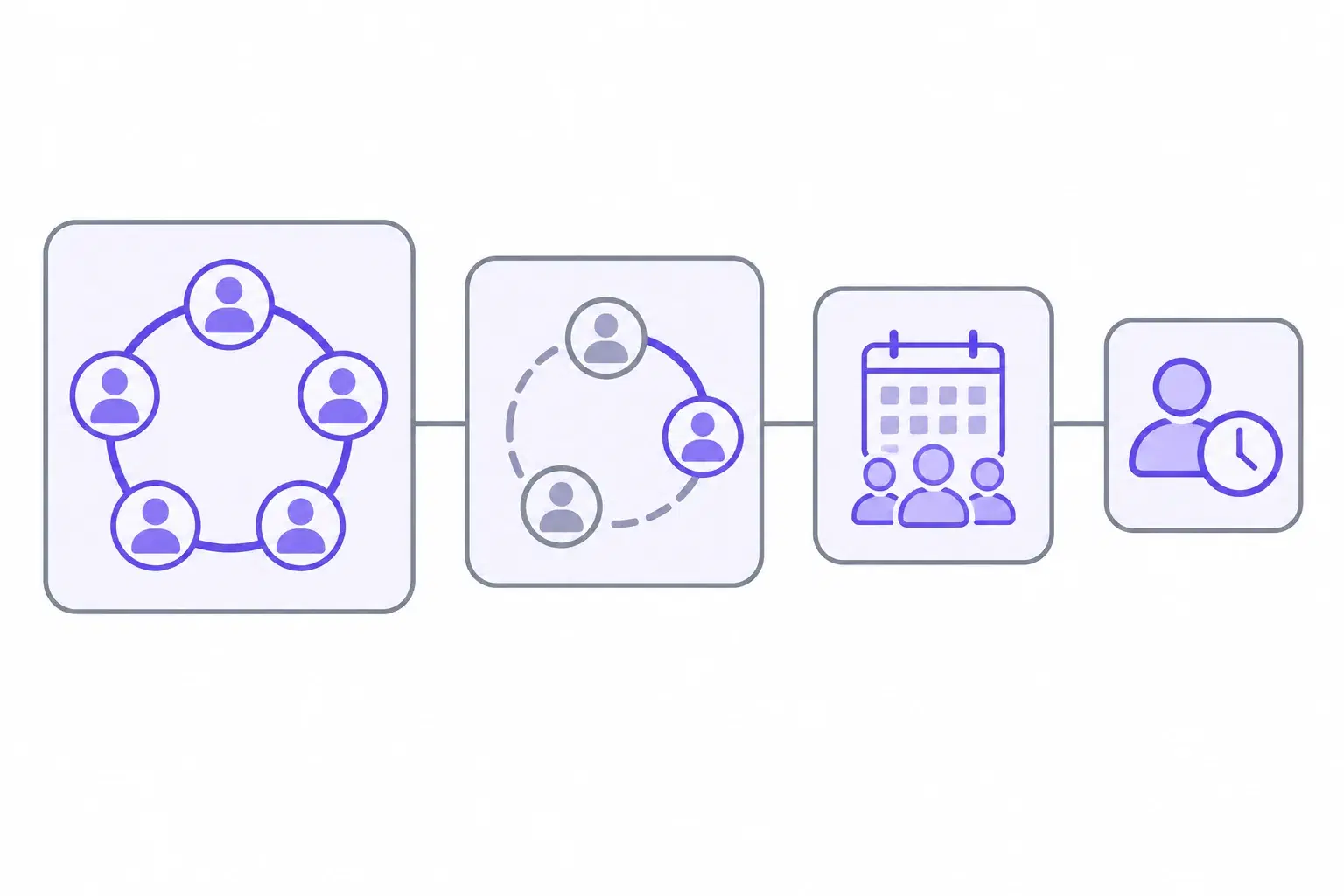
| Model | What's outsourced | Typical trigger | Commitment |
|---|---|---|---|
| Enterprise / Full Talent Lifecycle | Hiring across all skill sets and locations, end to end | Rebuilding or replacing the recruiting function | Highest — long-term, programme-wide |
| Hybrid / Select-Process / Staff Augmentation | Specific roles, departments, or process steps alongside your team | Internal team can't cover one area or stage | Medium — scoped to part of the process |
| On-Demand / Project | A defined set of openings on a set timeline | New site, product launch, seasonal surge | Lower — ends when the project does |
| Contingent | Sourcing temporary and contract labour | Large or growing contingent workforce | Varies — often alongside an MSP |
Model names from the RPO Association. Triggers and commitment levels are our summary.
Project RPO is where most first engagements start, on both sides of the table. It's the lowest-risk way for an employer to test the model — and, as we'll get to, the most natural entry point for a staffing agency.
RPO vs Staffing Agency vs In-House vs MSP
Here's the table nobody on page one publishes — mostly because everyone on page one sells one of the columns. Five ways to get people hired, compared on the things that actually decide the choice.
| RPO | Staffing agency | Contingent search | MSP | In-house | |
|---|---|---|---|---|---|
| Who owns the process | The RPO provider, designed with you | You; the agency works inside it | You | The MSP owns the contingent-labour programme, not permanent hiring | Your talent acquisition team |
| What you're buying | A recruiting function, run end to end or in part | Filled job orders and temp or contract workers | Candidates for a specific role | Management of your staffing suppliers | Your own recruiters' time |
| Typical commercial model | Cost per hire, management fee, FTE-based, or a blend | Temp margin on pay rates; perm fee on placement | Fee paid only on a successful placement | Programme fee; structures vary | Salaries, tools and ad spend |
| Contract length | Usually multi-year for enterprise; months for project RPO | Per job order, under a master agreement | Per search | Multi-year programme | Ongoing |
| Scales up and down | Within bands agreed in the contract | Fast, order by order | Search by search | Through the supplier panel | Slowly — through hiring and layoffs |
| Owns employer brand | Often manages it, in your name | No | No | No | Yes |
| Accountable for results | Yes — SLAs on the whole programme | For each fill, not the overall process | For that search only | For programme spend and compliance | Yes, internally |
| Typical use case | Sustained volume, rebuilding a function, multi-country hiring | Spiky demand, temp and contract labour, hard-to-fill roles | Specialist or senior single hires | Large contingent workforce across many suppliers | Steady hiring that needs deep product context |
| Whose ATS | Yours, or the provider's | The agency's own ATS and CRM | The firm's own | A vendor management system (VMS) | Yours |
Typical patterns, not rules — contracts vary widely. Free to cite with a link to this page.
Two rows do most of the work. Who owns the process and accountable for results are where RPO is structurally different from everything else on the list. A staffing agency is accountable for each fill. An RPO is accountable for the programme — including the parts it doesn't directly control, like how quickly your hiring managers return feedback. That's why RPO contracts spend so many pages on SLAs, and why the good ones spend almost as many on what the client owes the provider.
The MSP column trips people up most. An MSP manages your contingent workforce programme — the suppliers, the rates, the compliance — usually through a vendor management system. It isn't running permanent hiring. Large employers often have both, and the staffing agencies supplying temps sit underneath the MSP as vendors.
How Much Does RPO Cost?
Honest answer first: nobody publishes RPO rate cards. Not the providers, not the RPO Association, not the analysts. Any page that gives you a confident dollar range is guessing, or quoting a single deal as if it were a market.
What you can know is how the price is built. Nearly every engagement uses one of three commercial structures, or a blend:
Cost per hire
A fixed fee for each person hired, sometimes tiered by role level. Easy to understand and closely tied to output. The risk for the provider is a hiring freeze; the risk for you is a provider that optimises for count over quality.
Management fee (retainer)
A recurring fee to run the programme, often with a smaller per-hire component on top. Predictable for budgeting, and common in enterprise RPO where the provider carries fixed costs regardless of month-to-month volume.
FTE-based
You pay for dedicated recruiters, sourcers or coordinators, usually at a monthly rate per head. Closest to "renting a recruiting team" and the easiest to scale up or down — within whatever notice periods the contract sets.
What actually drives the number
- Volume and predictability — steady, forecastable hiring is cheaper per hire than lumpy demand
- Role complexity — scarce technical or senior roles cost more to fill than high-volume hourly ones
- Geography — the number of countries, languages and labour markets in scope
- Technology — whether the provider brings its own ATS, sourcing tools and reporting, or works in yours
What usually sits outside the fee
Job board and advertising spend, assessment licences, background checks, and ATS or other software licences are often passed through at cost or billed separately. Ask which line items are included before comparing two proposals — otherwise you're comparing a management fee against a management fee plus media.
What the RPO Market Looks Like
Two credible figures, measuring two different things.
Buyer spend: Staffing Industry Analysts put global RPO spend at $8 billion in 2023, down 5% on the year before (published October 2024). The Americas accounted for 50%, EMEA 30% and APAC 20%. And 81% of that spend went on ongoing programmes rather than one-off projects — which tells you most RPO is a long-term relationship, not a quick fix.
Market revenue: Grand View Research (July 2026 edition) sizes the RPO market at $12.8 billion in 2025 and forecasts $31.5 billion by 2033, a 12.1% compound annual growth rate. It gives North America a 41% share.
Two Market Sizes, Two Different Things
You'll see RPO's market size quoted as $8 billion and as $12.8 billion. Both are real. SIA measures buyer spend and reported $8bn globally for 2023. Grand View Research measures market revenue with a 2025 base year and reports $12.8bn. They're two years apart and measure different things — don't read the gap as growth.
On composition, SIA (citing its RPO Global Landscape Summary 2024) found finance and accounting (18%) and industrial (15%) are the largest occupational categories, with IT, healthcare and finance and accounting together making up 45%. Experienced hires account for 56% of the market. RPO is not just a graduate-scheme or warehouse-volume play.
The large global providers include Korn Ferry, Cielo, Randstad Sourceright, AMS, Hudson RPO, PeopleScout and WilsonHCG. If you want a structured view of who's strongest where, Everest Group's PEAK Matrix publishes an annual RPO assessment that groups providers into Leaders, Major Contenders and Aspirants, weighing market impact against vision and delivery capability. The full report is gated and placements move every year, so check the current edition rather than a provider's press release from two years ago.
When RPO Is the Right Answer — and When It Isn't
None of these models is better in the abstract. Each one is better at a specific shape of hiring demand.
RPO fits when
- Hiring volume is sustained, not a one-off spike — the overlap with high-volume hiring is large
- The hiring function needs rebuilding, not just topping up
- You're hiring across several countries and want one process
- You genuinely want to transfer accountability — and are prepared to hold up your side of the SLAs
A staffing agency fits when
- Demand is spiky or hard to forecast
- You need specialist, hard-to-fill roles filled
- You need temp or contract labour, fast
- You want speed on a specific job order without restructuring anything
In-house fits when
- Hiring is steady and predictable
- Employer brand is a genuine differentiator you want to own
- Roles need deep product or domain context to assess
They often coexist
At a large employer you'll regularly find all of them at once. An internal team owns executive and strategic hires. An RPO runs the high-volume permanent pipeline. Specialist agencies get the job orders the RPO can't fill in time. An MSP manages the temps. Each covers a different shape of demand.
Demand for RPO also moves with the hiring cycle. In Employ's 2024 Recruiter Nation Report (1,200+ talent acquisition decision makers), 17% of TA teams said they worked with RPO providers in 2024, down from 30% in 2023 — yet 40% of those increasing recruiting budgets named RPO investment a priority. A cooling market cuts outsourced recruiting first, and budgets come back to it when hiring picks up.
Why Staffing Agencies Are Adding RPO Desks
If you run an agency, you've probably heard some version of "RPO is where the margin is." Maybe. What's certainly true is that agencies are looking hard at new service lines, because the core business has been uneven.
Two recent surveys give two reads on 2025. StaffingHub's 2026 State of Staffing (231 US agencies) found 42% saw revenue decline in 2025. Bullhorn's GRID 2026 (around 2,300 firms, global) found 56% grew. Different samples, different geographies — and both point to a market where the winners and losers are pulling apart. In the Bullhorn data, 44% of top-performing firms are expanding consulting services and 40% are expanding candidate reskilling. That isn't a measure of RPO specifically, but it's the same instinct: sell more than the placement.

What changes: you're selling a process, not a placement
On a contingent desk, a bad month is a bad month. On an RPO desk, a bad month is an SLA conversation with a client who is paying you whether you placed anyone or not. That changes the job:
- Recruiters become dedicated to a client programme, often working in the client's brand
- You own the funnel, not just the submission — including the stages that stall on the client side
- Revenue gets steadier under a management fee or FTE model, but margin depends on how well you forecast capacity
- The sale is longer and lands with HR and procurement, not just the hiring manager — the business development motion looks different from a contingent pitch
What your tech stack needs to do differently
Most agency systems are built around the job order. An RPO desk needs a few things a contingent desk can live without:
- Client-specific workflows — different stages, screening questions and templates per programme
- Multi-client segregation, so one client's pipeline and data never leak into another's
- Hiring manager access to review candidates and give feedback without email chains
- SLA and funnel reporting per programme — time to hire, stage conversion and hiring manager response times (see our guide to recruitment metrics for staffing agencies)
- Capacity without headcount — because the contract fixes your fee, every extra recruiter you hire to hit the SLA comes out of margin
That last point is where tooling decides the economics. If you run your ATS and CRM as separate systems, this is also where the gaps show — the staffing CRM vs ATS question gets sharper when a client is reading your reports every week. At HRmony we built Crew — custom AI agents for sourcing, outreach and screening that run 24/7 and can be set up per role or per client — for exactly this kind of desk, running on one native ATS, CRM, sourcing and automation base instead of four tools. Ask any vendor, us included, to demo per-client segregation and per-programme reporting before you sign the first RPO contract.
What to charge for — and how to price a pilot
The safest first step is project RPO for a client you already place with. You know their hiring managers, their roles, and where their process stalls. A practical pilot looks like this:
- Scope a defined set of openings on a fixed timeline — a new site, a team build, a seasonal surge
- Price on an FTE or management fee basis, with a per-hire component if the client wants skin in the game
- Agree two or three SLAs you can measure from day one, and the client-side commitments that make them achievable
- Charge separately for pass-through costs — advertising, assessments, background checks
- Review at the end with data, then propose the ongoing programme
The pilot's real job is proving you can run a process, not just fill roles. Get that right once and the conversation about a longer contract mostly writes itself.
Run an RPO desk without hiring a second team
HRmony's Crew agents source, reach out and screen 24/7, configured per role or per client, while Pulse ranks every candidate already in your database against a new role in under two minutes. All of it runs on one native ATS + CRM + sourcing + automation platform. See what's included on the pricing page.
See Pricing →FAQ: Recruitment Process Outsourcing
What is recruitment process outsourcing?+
How much does RPO typically cost?+
What's the best recruitment process outsourcing company?+
What's the difference between RPO and a staffing agency?+
What does RPO stand for?+
What's the difference between RPO and MSP?+
Is RPO worth it?+
Can a staffing agency offer RPO services?+
Further Reading
Martin Gordon
Co-founder & CEO, HRmony.ai
Martin has 15+ years in recruiting technology and talent operations. He co-founded HRmony.ai to give staffing agencies — including the ones running RPO programmes — one AI-native platform for their ATS, CRM, sourcing and automation, so capacity grows without headcount growing with it. About HRmony
Thinking about adding an RPO desk?
Start with one platform that handles the ATS, the CRM, sourcing and the AI agents in the same place.
Try HRmony →