
Quick Answer
High-volume recruiting means filling many similar roles at once — typically frontline, hourly or shift work — where the constraint is processing throughput rather than finding candidates. Aptitude Research defined it in 2021 as more than 1,000 positions at a time or more than 1,000 applications per position, though most agencies hit the same operational problems well below that. The funnel breaks in three predictable places: application length, time to first response, and interview scheduling.
A client calls on Tuesday. They need 60 pickers on site by the first of the month, and they'd like the first 20 by next Monday. You already know the job order is fillable. The candidates exist. What you don't know is whether your desk can process them fast enough.
That's the honest shape of high-volume recruiting for a staffing agency. It's a throughput problem, not a sourcing problem. Once you know your conversion rates, the number of recruiters you need is arithmetic — and almost every point of leverage sits in the first hour after someone applies, not in the sourcing that happens before it.
Most guides on this topic are written for in-house talent teams. This one is written for the agency desk: the funnel math with real published benchmarks, the five places volume funnels actually break, and a seven-step playbook for handling the volume without adding recruiters you can't afford.
TL;DR — Key Takeaways
| The problem | The number | The fix |
|---|---|---|
| Applications are too long | 1–5 minute applications get ~4x the apply rate of 15+ minute ones (Appcast, 2022–2024) | Cut to under 5 minutes |
| Nobody responds fast enough | 94% of organisations don't schedule interviews inline at apply (Phenom/Aptitude, 2026) | Automate first touch and scheduling |
| Candidates ghost | 62% of US job seekers plan to ghost again (Indeed, 2023) | Shrink the gap between apply and interview |
| Offers fall through | Offer acceptance 51% in Q2 2025 vs 74% in Q2 2023 (Gartner) | Shorten offer-to-start; confirm proactively |
| You're buying traffic you don't need | 180 applicants per hire on average (CareerPlug, 2024 data) | Re-engage your own database first |
What Counts as High-Volume Hiring?
There are three useful definitions, and they get more practical as you go down the list.
The numeric threshold
Aptitude Research and Fountain's State of High-Volume Recruitment — a 2021 survey of 420 companies — defined it as "more than 1,000 positions at a time or receiving more than 1,000 applications per position." In that 2021 sample, 65% of companies had high-volume needs and 82% expected them to continue or increase.
The contextual definition
iCIMS (August 2026) frames it as frontline roles at scale across retail, healthcare, hospitality, manufacturing and logistics — and recommends diagnosing it by process metrics: application-to-first-contact time, scheduling turnaround, time-in-stage and drop-off by stage. Not by headcount.
The agency definition
You're doing high-volume hiring when your process breaks before your pipeline does. A 40-head job order can qualify if your desk of three can't reply to applicants the same day.
The third one is the one that matters. A 1,000-application threshold tells you nothing about whether your desk is coping. Time from apply to first contact tells you everything.
The High-Volume Recruiting Funnel Math
Every competing guide tells you to "streamline your process." None of them gives you numbers you can multiply. Here are the published stage benchmarks, each with its own source and the population it actually measured.
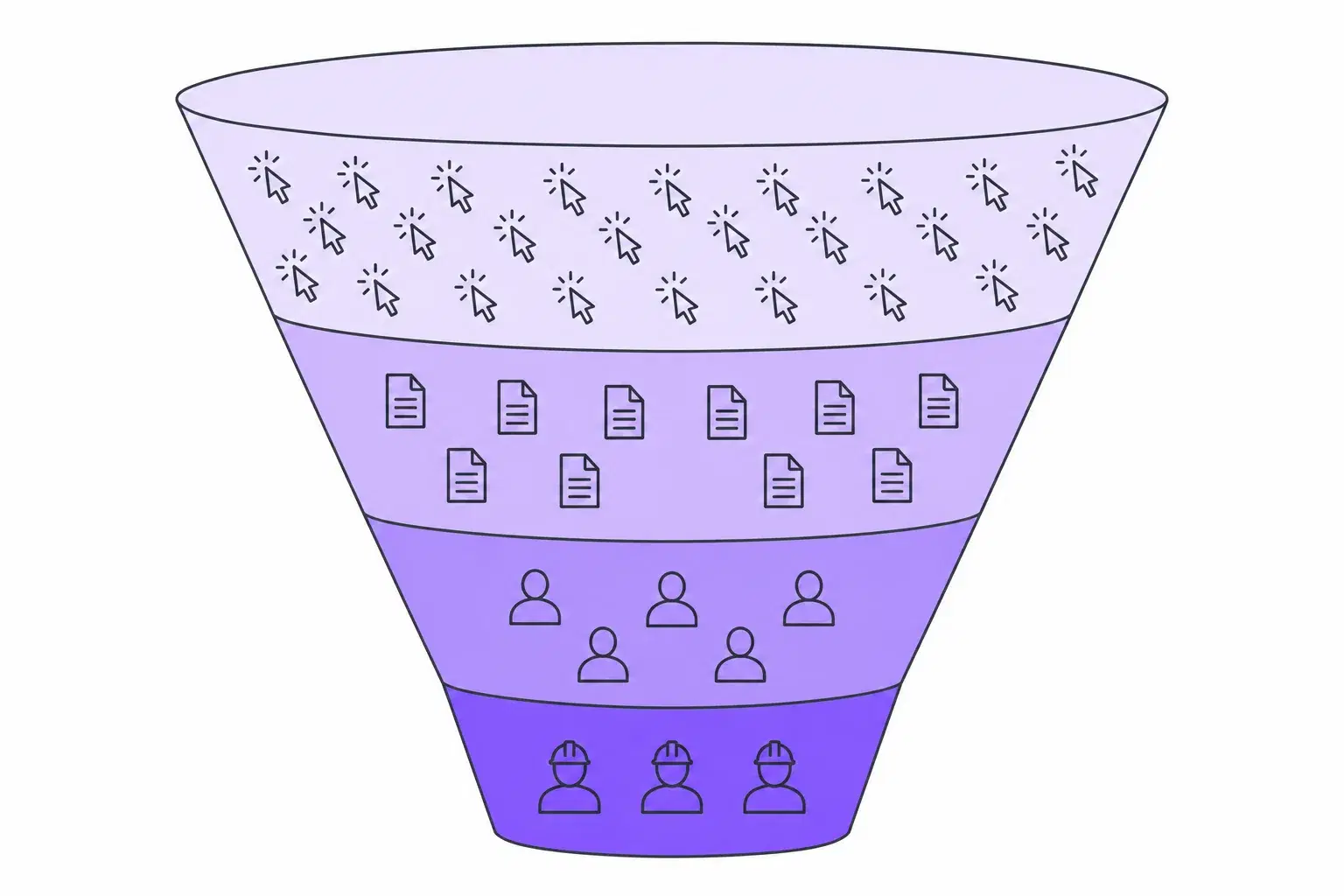
| Stage | Benchmark rate | Source | Population measured |
|---|---|---|---|
| Job ad click → apply | 5.19% (2025, all industries); technology 7.14% | Appcast, 2026 Recruitment Marketing Benchmark Report (Feb 2026) | 302m+ clicks, 27m applications, ~1,200 US employers |
| Job ad click → apply (SMB / hourly) | 6% | CareerPlug (Apr 2025) | 60,000+ US small businesses, 10m+ applications, 2024 hiring activity |
| Applicant → interview | 3% | CareerPlug (Apr 2025) | As above |
| Interview → hire | 27% | CareerPlug (Apr 2025) | As above |
| Applicants per hire (end to end) | 180:1 average; automotive 234:1; education & childcare 57:1 | CareerPlug (Apr 2025) | As above |
| Offer → acceptance | 51% (Q2 2025), down from 74% (Q2 2023) | Gartner (Jul 2025) | 2,918–3,290 candidates, surveys 4Q24–2Q25 |
Note: These are published averages from three separate datasets measuring different populations, not stages of one measured funnel. Use each as a benchmark for its own stage. The end-to-end applicants-per-hire figure is the one to plan against.
Cite this table: "High-Volume Hiring Funnel Benchmarks," HRmony.ai, October 2026 — hrmony.ai/blog/high-volume-hiring-playbook#high-volume-funnel-benchmarks. Sources: Appcast, CareerPlug, Gartner.
Why you shouldn't multiply the stages together
It's tempting to chain the rows. Don't. CareerPlug's own figures show why: 3% applicant-to-interview times 27% interview-to-hire implies roughly 123 applicants per hire — but CareerPlug separately publishes an average of 180. Both are correct. They're averages across different denominators and different subsets of the same businesses. They are not a chain.
One more trap: Appcast's 2025 report put the 2024 apply rate at 6.1%, and its 2026 report puts 2025 at 5.19%. That looks like a decline. It almost certainly isn't one — the two editions use different measurement bases. Pick one, cite its year, and don't draw a trend line between them.
The worked example: 50 roles, backwards through the funnel
So use one dataset's end-to-end ratio. At CareerPlug's small-business and hourly average of 180 applicants per hire, filling 50 roles takes roughly 9,000 applications. At CareerPlug's 6% click-to-apply rate, that's about 150,000 job ad clicks.
Sit with that for a second. Fifty heads. A hundred and fifty thousand clicks. Now try the calculator with your own job order.
Funnel Calculator
How many applications and ad clicks does your job order need?
Applications needed
9,000
50 hires × 180 applicants per hire
Job ad clicks needed
150,000
9,000 applications ÷ 6% click-to-apply
Source: CareerPlug, 2024 hiring activity across 60,000+ US small businesses and 10m+ applications (published April 2025). Uses CareerPlug's end-to-end applicants-per-hire averages (180 all industries, 234 automotive, 57 education & childcare) and its 6% all-industry click-to-apply rate. These are small-business averages, not agency-specific benchmarks — swap in your own desk's ratio as soon as you have one.
The calculator divides by 6% for every sector because CareerPlug publishes one all-industry click-to-apply rate; it doesn't publish sector-specific ones.
Why the ratio varies so much by sector
If your sector runs closer to automotive's 234:1, those 50 roles need 11,700 applications and nearly 200,000 clicks. At education and childcare's 57:1, it's 2,850 applications. Same job order size. A fourfold difference in the work.
CareerPlug doesn't break down the cause, but the gap most likely reflects how many applicants fail the hard requirements — certifications, background checks, shift availability, travel distance — and how specialised the candidate pool is. Which is exactly why your own ratio by client and role type beats any published average. Treat 180:1 as the starting estimate, not the answer.
The Five Places High-Volume Funnels Break
Volume desks rarely fail because they ran out of candidates. They fail at five specific points, and the industry has automated almost none of them.
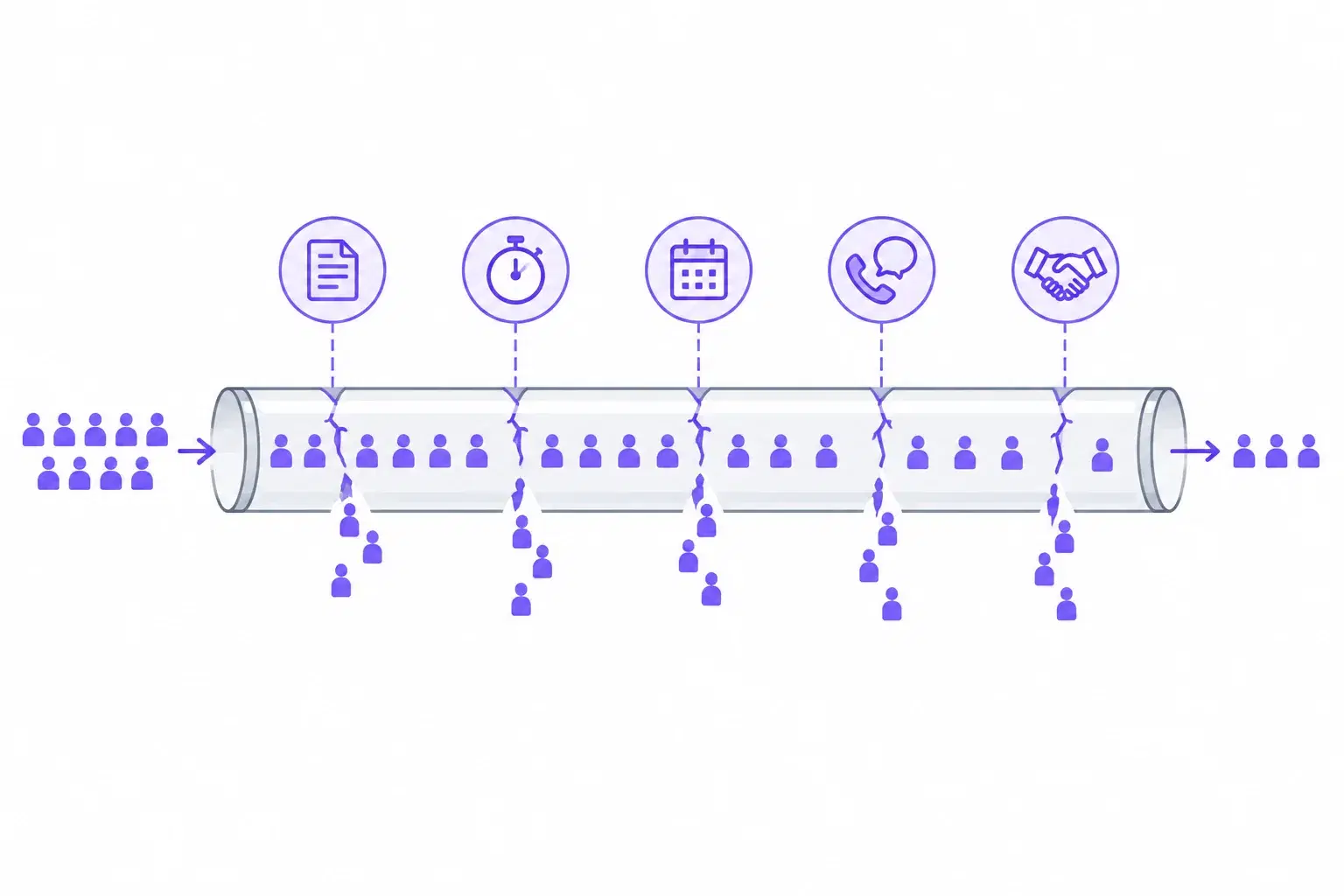
The Gap After Apply
94% of organisations don't offer automated interview scheduling inside the apply flow. 99% don't use AI voice screening inline. 99% don't deploy one-way video inline. 89% don't run assessments inline. Yet 72% rate their inline candidate experience "effective" or "very effective."
Phenom / Aptitude Research, State of Hiring Automation 2026, May 2026. Only 1% of organisations scored high maturity for hiring automation.
Read that twice. The industry has automated everything before Apply — job distribution, programmatic ads, sourcing — and almost nothing after it. Then it rates the result as effective. That pretty much sums up the problem.
1. Application length
Appcast's data, published in 2022–2023 and updated in 2024, found applications taking one to five minutes see apply rates roughly four times higher than those exceeding 15 minutes — long applications cut conversion from about 12–13 applicants per 100 clicks to just 3–4. Degradation starts past five minutes and gets severe past 15. In the UK, Appcast's April 2026 report (3.6m clicks, 880k applications, 190+ UK employers) found higher apply rates went alongside applications under five minutes, mobile-friendly experiences and shorter job titles — a correlation, but a consistent one.
2. Time to first response
This is the automation gap above in action. Somebody applies at 9pm from their phone. If the first human contact is a call at 11am two days later, you're competing with every agency that texted them back that evening. iCIMS lists application-to-first-contact time as the first metric to diagnose a volume process — for good reason.
3. Interview scheduling
Scheduling is where recruiter hours disappear: messages back and forth, a rescheduled slot, a reminder nobody sent. The published evidence here is vendor-supplied, so read it as a best case. Paradox reports that NCS Group, a 12,000-person consulting organisation in Asia Pacific that previously had three people scheduling 500 candidates a week, saw an 83% decrease in time to schedule and a 26% decrease in interview cancellations after automating it (vendor-published case study, undated).
4. Ghosting and no-shows
Indeed's Ghosting in Hiring research — fielded in April–May 2023 across 4,516 job seekers and 4,517 employers in the US, UK and Canada — found 61% of US job seekers had ghosted two to four employers in the previous 12 months. 62% planned to do it again, up from 56% in 2022 and 37% in 2019. And 89% of employers called ghosting a problem.
What about interview no-show rates for hourly roles? Honest answer: nobody publishes a credible one. The figures you see quoted trace back to unnamed "industry research." Your own show rate, tracked by client and shift type, is the only number worth managing to.
5. Offer-to-start drop-off
Gartner found candidate offer acceptance fell to 51% in Q2 2025 from 74% in Q2 2023 (surveys of 2,918–3,290 candidates, 4Q24–2Q25). For a volume desk, the risk extends past acceptance to the first shift itself. Every day between "yes" and start date is a day another offer can land.
The High-Volume Hiring Demand Picture in 2026
Labour-market figures last updated . We re-check JOLTS, BLS and iCIMS figures quarterly.
The backdrop for agencies is unusually favourable — and unusually awkward.
Temp Is Where the Growth Is
Of more than 300 industries tracked by the BLS, temporary help services added the second-highest number of jobs in 2026, growing every month this year (+3,400 in July). In the words of Noah Yosif, the American Staffing Association's chief economist, "one in ten jobs created this year have been temporary positions."
Noah Yosif, Chief Economist, ASA, writing in Fortune, August 24, 2026. Temp help services employment stood at 2,505.0 thousand in July 2026 (BLS via FRED, TEMPHELPS); SIA's July 2026 US Jobs Report puts the temp penetration rate at 1.57% for June 2026.
Now the awkward part. iCIMS' August 2026 Insights report (3.1m+ platform users, 691m candidate profiles) found frontline job openings up 9% year over year while application volume fell 18%. Nationally, openings rose 17% and applications rose 6% — but hires were flat. Manufacturing was the starkest: openings up 29%, hires down 6%.
The BLS JOLTS release for June 2026 (published August 4, 2026) tells the same story from a different angle: 7.4 million openings (4.4%), 5.3 million hires (3.4%), 5.4 million separations, 1.8 million layoffs, and 3.2 million quits — a quits rate of just 2.0%, historically low.
Put those together and the implication for a volume desk is blunt. Demand is up. Fresh applicant supply is not. Candidates aren't moving much on their own. Which means the people you've already screened, placed or nearly placed are worth more than new traffic you'll pay for — and re-engaging your own database beats buying more clicks.
The Agency Playbook: High-Volume Recruiting Strategies That Work
Here's the direct answer to the question every agency owner asks about volume: how do you handle it without adding recruiters? You take recruiters out of the steps that don't need judgment, and you stop paying to re-find candidates you already have. Seven moves, in order.

1 — Instrument the funnel before you fix it
You can't staff to a funnel you can't see. Before you change anything, measure time from application to first contact, time to a booked interview, show rate, offer acceptance, offer-to-start and applicants per placement — by client and by role type. Our guide to recruitment metrics for staffing agencies covers how to set each one up without a data team.
2 — Cut the application to under five minutes
Ask only what you need to screen: name, phone, location, shift availability, and the two or three hard requirements for the job order. No account creation. No CV upload as a gate. Everything else — work history, references, right-to-work documents — gets collected after the candidate is engaged and has a reason to finish.
3 — Respond in minutes, not days
Every applicant should get an immediate, specific reply — by SMS for hourly roles, because that's where shift workers actually are — confirming the role, the next step and when it will happen. Knockout questions can go in the same thread. Our look at AI recruiting chatbots covers where this works well and where candidates push back.
4 — Automate scheduling completely
Not "send a booking link." Completely: self-service booking straight from the screening thread, self-service rescheduling, automatic reminders the day before and the morning of, and a waitlist that backfills cancelled slots. If a recruiter is touching a calendar for a first-round volume interview, that's a process gap. Our guide to recruitment automation for staffing agencies goes step by step through what to automate first.
5 — Build the redeployment loop
Your best source for the next job order is the last one. Bullhorn's GRID 2026 industry trends report found 85% of staffing firms with redeployment plans report placement times under 20 days. Yet StaffingHub's 2026 State of Staffing report (US, 231 firms) found 48% of agencies don't track redeployment rate at all.
Note that the Bullhorn figure is correlational — firms organised enough to plan redeployment are probably organised in other ways too. But the mechanism is obvious: a worker finishing an assignment is already vetted, already compliant and already knows your process. Trigger outreach two weeks before every assignment end date. Treat redeployment as a CRM function, not just an ATS record.
6 — Staff the desk to the funnel, not to the req count
Once you have your own ratios, recruiter capacity becomes a division problem. Work backwards from the steps that still need a human — usually the final phone screen, the client submission and the offer call — and ignore the steps automation now handles.
Desk-sizing worksheet (use your own numbers)
- Hires needed on the job order × your applicants per hire = applications.
- Applications × the share that pass automated knockouts = human screens.
- Human screens ÷ screens one recruiter completes per day = recruiter-days.
- Recruiter-days ÷ working days until the start date = recruiters on the desk.
There's no credible public benchmark for screens or placements per recruiter — those figures sit in members-only surveys. Use what your own desk actually does.
The lever that matters is step two. Every point of knockout screening you automate comes straight off the recruiter-days line. iCIMS' 2026 frontline research with Lighthouse Research & Advisory (463 TA professionals across healthcare, manufacturing, retail, hospitality, transportation and construction, fielded Q1 2026) found 75% of high-volume employers report AI has reduced recruiter workload, and 48% are increasing AI investment based on results.
7 — Manage the client with funnel numbers, not adjectives
"We're working hard on it" is an adjective. Something like this (illustrative numbers) — "Sixty heads at our current ratio means about 10,800 applications; we're at 4,200 with a 3-day apply-to-interview time, and a $1 raise on the night shift would likely move that faster than more ad spend" is a plan. Funnel numbers let you push back on pay rates, shift patterns and start dates with evidence — and they make your agency look like the expert in the room, which is the whole point of being one. For more on that conversation, see our guide to recruitment agency business development.
What High-Volume Recruiting Tools Actually Need to Do
Before you look at any high-volume hiring software, define the job. Here's the capability list, and what "good" looks like for an agency desk rather than an in-house team.
| Capability | Why it matters at volume | What "good" looks like |
|---|---|---|
| Bulk job posting & distribution | One job order often means dozens of near-identical ads across locations and boards | Post once, distribute everywhere, track source per applicant |
| Mobile-first apply under 5 minutes | Hourly candidates often apply from a phone, and often outside working hours | No login, no CV gate, under five minutes end to end |
| Instant auto-response | The first reply decides whether you're the agency they talk to | Specific, role-aware reply within minutes, any hour |
| Automated scheduling with self-service rescheduling | Calendar ping-pong is where recruiter hours vanish | Candidate books and reschedules without a recruiter touching it |
| SMS as primary channel | Shift workers live in text messages, not inboxes | Two-way SMS threads logged to the candidate record |
| Bulk screening with human review | Thousands of applicants can't be read one by one — but decisions need a person | Automated knockouts and ranking; a recruiter signs off on every rejection rule |
| No-show reminders | Every empty interview slot is wasted capacity | Day-before and morning-of reminders with one-tap confirm |
| Redeployment triggers | Finishing workers are your cheapest next placements | Automatic outreach ahead of assignment end dates |
| Funnel reporting by stage | You can't staff the desk without your own ratios | Apply-to-contact, apply-to-interview, show rate and applicants per placement by client |
One test cuts through most demos: ask what happens to a candidate who applies at 11pm on a Saturday. If the answer involves a recruiter on Monday morning, it isn't a volume tool. For a wider view of the categories, see our roundup of the best recruiting tools.
Wake up the candidates you already paid for
At 180 applicants per hire, your database is full of people who almost got placed. HRmony's Pulse ranks every candidate already in your ATS against a new job order in under two minutes, Aura keeps every profile current 24/7, and Crew agents handle outreach and first-line screening around the clock — so the desk scales placements without scaling headcount. All of it runs on one native ATS, CRM, sourcing and automation base. See what's included on the pricing page.
See Pulse in Action →FAQ: High-Volume Recruiting
What is high-volume hiring?+
What is considered high-volume recruiting?+
How many applicants does it take to make one hire?+
How do you manage high-volume hiring without hiring more recruiters?+
Why do candidates ghost during high-volume hiring?+
How long should a job application take?+
What metrics should you track for high-volume recruiting?+
What's the difference between high-volume hiring and regular recruiting?+
Further Reading
On HRmony
Martin Gordon
Co-founder & CEO, HRmony.ai
Martin has 15+ years in recruiting technology and talent operations. He co-founded HRmony.ai on a simple bet: AI that lives inside the recruiting workflow — knowing your candidates, clients and job orders — does more for a volume desk than another tool bolted on beside it. About HRmony