
Quick Answer
Recruitment automation uses software to run the repeatable parts of the hiring process — sourcing, screening, scheduling, follow-up, redeployment outreach — without a recruiter doing them by hand. For staffing agencies the highest-return workflows are candidate re-engagement, interview scheduling and submission follow-up. The workflows you should not automate are the ones that make an irreversible decision about a person.
Somebody has told you to "use AI." Fair enough. But you can't add recruiters, billings still need to grow, and every vendor demo looks the same: a dashboard, a chatbot, a slide with a number on it you can't quite trace.
Most writing on recruitment automation targets in-house talent teams. This is for an agency desk: what automation is, nine workflows from job order to redeployment, the evidence graded honestly, and four decisions never to hand to a machine.
Then the part almost nobody covers: the compliance layer. New York City's AI hiring law names employment agencies explicitly. Not just employers. You.
TL;DR — Key Takeaways
| Workflow | Automate it? | Why |
|---|---|---|
| Interview scheduling | Yes, fully | 35% of recruiter time goes to coordination (Phenom/Aptitude, 2026); zero judgement required |
| First-touch candidate response | Yes | Speed is the whole game, and it's reversible |
| CV parsing & enrichment | Yes | Data entry, not decision-making |
| Redeployment outreach | Yes — highest leverage | 85% of firms with redeployment plans place in under 20 days (Bullhorn GRID 2026) |
| Candidate ranking / scoring | Only with human review | Documented bias risk; regulated in several jurisdictions |
| Final rejection | No | Irreversible; legal exposure |
| Client bad-news calls | No | Relationship-defining |
| Offer negotiation | No | Judgement and trust |
What Recruitment Automation Actually Means
Definition
Recruitment automation is the use of software to run the repeatable steps of hiring — sourcing alerts, CV parsing, screening questions, interview scheduling, follow-up and redeployment outreach — on rules and triggers, so recruiters spend their hours on candidate and client conversations instead of admin.
That definition is deliberately boring. The word "automation" gets used for three quite different things, and most bad buying decisions come from mixing them up.
Automation vs AI vs agentic AI
Automation
Rules. No feedback 48 hours after a submission, nudge the hiring manager. No intelligence, perfectly predictable — which is the point.
AI (generative assistance)
Models that write, summarise and extract: a draft job ad, a parsed CV, a call summary. A human reads the output.
Agentic AI
Software that takes multi-step action on its own: finds candidates, sends outreach, books the call — without a person triggering each step.
The three layers: triggers, assistance, agents
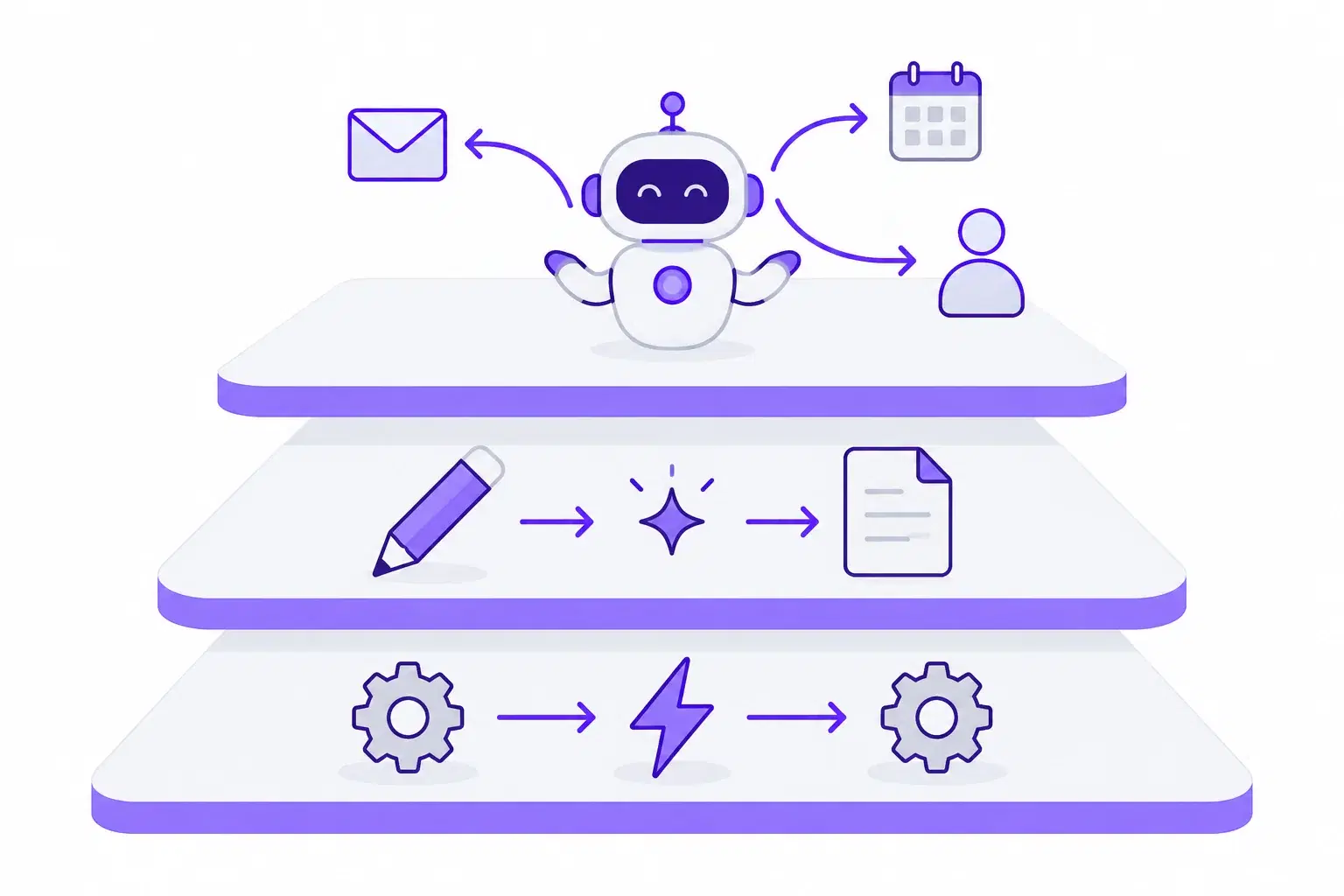
Think of them as a stack: rules-based triggers at the bottom, generative assistance in the middle, agentic workflows on top. Each layer amplifies whatever sits underneath, including messy data. An agent running on stale records just contacts the wrong people faster.
The industry is mostly in the middle of that stack, not the top. 30% of recruitment firms now use agentic AI tools, but only 10% have AI embedded across the full workflow, according to Bullhorn's GRID 2026 report (n≈2,300, fielded November–December 2025). A separate study puts the median organisation at roughly 17% of its maximum automation potential, with fewer than 1% running fully integrated qualification workflows (Phenom/Aptitude Research, May 2026).
Translation: the agencies pulling ahead aren't the ones with the cleverest agent. They're the ones that got the boring bottom layer working.
Where Recruiter Time Actually Goes
Forget the "80% of time on admin" line that gets passed around. Nobody can trace it to a study. Here are two that do exist.
17.7 hrs
of manual admin per vacancy — over two working days per hire
35%
of recruiter time spent on interview coordination alone
1,062 hrs
of admin a year at 60 job orders — illustrative arithmetic
Totaljobs and The Stepstone Group (August 2025, 748 HR leaders and 2,025 jobseekers) found 17.7 hours of manual admin per vacancy and an estimated ~£17,000 annual productivity loss per recruiter. That sample is HR leaders, not agency recruiters specifically, so treat it as a reference point rather than your number.
The Phenom/Aptitude Research State of Hiring Automation 2026 (May 2026) puts the biggest single chunk on scheduling: 35% of recruiter time goes to interview coordination alone.
Now put that on an agency desk. A recruiter working 60 job orders a year at 17.7 hours each carries over 1,000 hours of admin — roughly half a full-time recruiter's year. That's back of the envelope, not a benchmark. But run it with your own job order count and it tends to end the "should we bother" conversation.
The interesting part isn't where those hours go. It's where they don't: candidate conversations and client conversations. The only two activities on a desk that produce a fee.
The 9 Recruitment Workflows Worth Automating
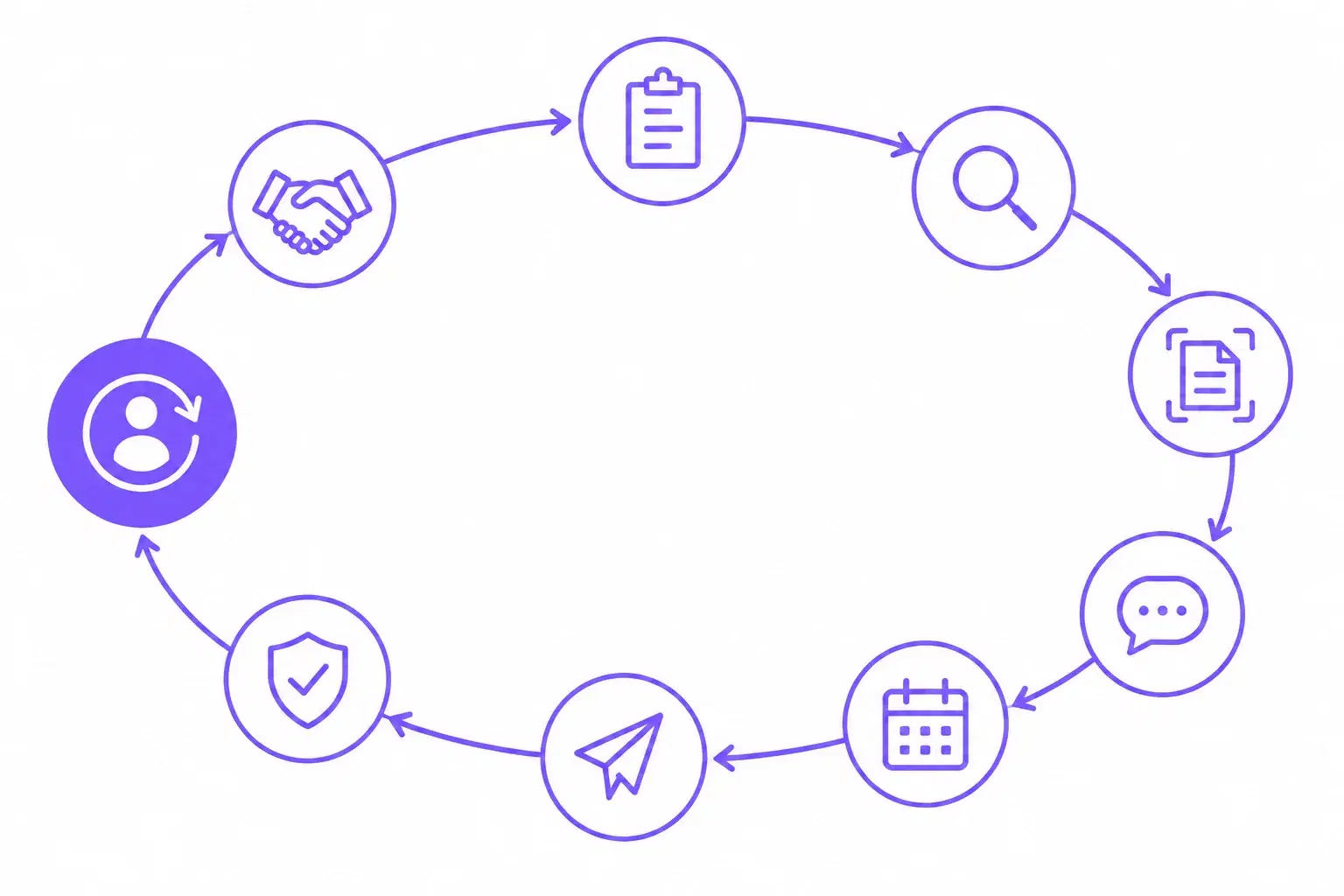
These follow the life of a job order: intake, sourcing, submission, placement, then back round to redeployment. Each one gets the same four lines, and the fourth one matters most. A list of things to automate without a list of how each one fails is a vendor brochure.
1. Job order intake and requirement capture
- What it is:
- A structured intake template that turns a hiring manager call into a complete job order — rate, must-haves, interview stages, start date, fee terms — and drafts the ad from it.
- Trigger:
- A new job order is created, or a client brief lands by email.
- What good looks like:
- No sourcing starts until the mandatory fields are filled. The recruiter edits a draft ad instead of writing one.
- What breaks if you get it wrong:
- A polished ad generated from a vague brief means you source perfectly against the wrong role. Automate the capture, never the qualification call.
2. Candidate sourcing and search alerts
- What it is:
- Saved searches across your database and the boards you pay for, re-running on their own against open job orders.
- Trigger:
- A job order opens, or a new or updated profile enters the database.
- What good looks like:
- Matches land in the recruiter's working queue. Already mainstream: 54% of recruitment firms automate candidate search (Bullhorn GRID 2026, n≈2,300).
- What breaks if you get it wrong:
- Alert fatigue. Fifty weak matches a day teaches a recruiter to ignore all of them. Tighten the criteria before you turn up the volume.
3. CV parsing and enrichment
- What it is:
- Extracting CV data into the record, then keeping it current instead of letting it decay from the day it was imported.
- Trigger:
- A CV arrives, or a record goes untouched for a set number of months.
- What good looks like:
- Nobody retypes a CV, and last year's candidates are still findable this year.
- What breaks if you get it wrong:
- Bad parsing quietly corrupts every later search. Spot-check a weekly sample for the first month. And a parsed graduation year or employment gap must never become a filter.
4. First-touch response and screening questions
- What it is:
- An instant acknowledgement plus a few knockout questions: right to work, location, availability, rate.
- Trigger:
- An application or inbound candidate enquiry.
- What good looks like:
- Every applicant hears back in minutes and the recruiter calls the ones who pass. The load is real: 72% of HR leaders cite screening irrelevant applications as a top slowdown (Totaljobs, Aug 2025).
- What breaks if you get it wrong:
- Knockouts that drift into judgement. "Do you hold a forklift licence?" is a knockout. "Tell us why you're a fit," scored by a model, is ranking — with different law attached.
5. Interview scheduling and rescheduling
- What it is:
- Self-serve booking against client and candidate calendars, with reminders and a reschedule link.
- Trigger:
- The client asks to interview a submitted candidate.
- What good looks like:
- Slot options go out the same day and nobody plays email tennis across three diaries.
- What breaks if you get it wrong:
- Double-book a client's panel once and they remember it longer than any placement you made. Pilot with one forgiving client.
6. Submission follow-up with the client
- What it is:
- A timed nudge to the hiring manager after a submission, and an honest status update to the candidate.
- Trigger:
- No feedback 48 hours after a submission (pick your own number).
- What good looks like:
- No submission sits in a client's inbox while your candidate accepts an offer elsewhere.
- What breaks if you get it wrong:
- Automated chasers to a client mid-crisis read as nagging. One automated nudge, maximum. The second chase is a phone call.
7. Reference and compliance document chasing
- What it is:
- Requesting and chasing references, right-to-work documents, certifications and expiring contractor paperwork.
- Trigger:
- An offer is accepted, a start date is set, or a document nears expiry.
- What good looks like:
- Nobody starts without complete documents, and expiries are flagged weeks ahead.
- What breaks if you get it wrong:
- The system marks the wrong document "received." Chasing can be automated; checking validity stays human, because a worker starting without valid right-to-work is a legal problem.
8. Redeployment outreach when a contract ends
- What it is:
- Contacting contractors and temps before their assignment ends, with roles that fit.
- Trigger:
- Assignment end date minus 30 days (or your market's lead time).
- What good looks like:
- The highest-leverage workflow on an agency desk. 85% of firms with redeployment plans place in under 20 days (Bullhorn GRID 2026), yet 48% of agencies don't track redeployment rate (StaffingHub 2026, n=231). A redeployed worker is already vetted and known to you.
- What breaks if you get it wrong:
- Messaging a contractor about their assignment ending before the client has told them. Sync the trigger with the account manager, or a leak costs you the client.
9. Client re-engagement on dormant accounts
- What it is:
- A short, relevant sequence of touches to clients who've gone quiet.
- Trigger:
- No new job order from an active client in 90 days.
- What good looks like:
- Each touch carries something useful — an available candidate, a note from your own placement data — and aims for a booked call.
- What breaks if you get it wrong:
- A "just checking in" sequence landing on a client whose last placement fell through. Exclude accounts with open issues.
Workflow 8 is usually left to a good recruiter's memory. It's really a CRM function — an end date, a relationship and a trigger — which is why it sits awkwardly in a pure ATS (more in staffing CRM vs ATS).
For what candidates accept from a bot in workflow 4, see AI recruiting chatbots. For temp and light-industrial desks, the high-volume hiring playbook goes deeper on volume.
What the ROI Data Actually Shows
Honest caveat up front: almost all published evidence on recruitment automation ROI is survey or vendor data. That doesn't make it useless, but you should know which kind you're reading. The table grades every source on one of four fixed ratings — including HRmony's own claim.
| Claim | Figure | Source | Strength of evidence |
|---|---|---|---|
| AI cut screening time | 46% say AI cut screening time in half or better | Bullhorn GRID 2026 (n≈2,300, fielded Nov–Dec 2025) | Survey correlation |
| AI screening improved KPIs | 55% report AI screening improved KPIs by more than 25% | Bullhorn GRID 2026 (n≈2,300) | Survey correlation |
| Fast-growing firms use embedded AI | 78% of firms growing revenue more than 25% use AI tools embedded in their ATS | Bullhorn GRID 2026 (n≈2,300) | Survey correlation |
| Deeper AI adoption, less contraction | Revenue contracted in 2025 for 56% of firms with no AI, 41% using it in 1–2 processes, 34% in 3–4, 31% in 5+ | StaffingHub 2026 State of Staffing (n=231) | Survey correlation |
| Use cases most associated with growth | JD generation 2.7x · reporting/analytics 2.7x · recruiting chatbots 2.3x · candidate qualification 2.2x | StaffingHub 2026 State of Staffing (n=231) | Survey correlation |
| Redeployment plans and speed | 85% of firms with redeployment plans place in under 20 days | Bullhorn GRID 2026 (n≈2,300) | Survey correlation |
| LLM CV screening is biased | White-associated names favoured 85% of the time vs Black-associated names 9% | Wilson & Caliskan, University of Washington, AAAI/ACM AIES (Oct 2024) | Peer-reviewed |
| AI matching improves placements | 35% better placements from HRmony Pulse surfacing existing candidates | HRmony (our own product claim) | Vendor-published |
Peer-reviewed: published through academic peer review. Platform data: measured from product telemetry across a disclosed population. Survey correlation: self-reported survey data showing an association — never causal. Vendor-published: a vendor reporting outcomes for its own product, with no independent audit.
The most quoted finding is that 78% of firms growing revenue by more than 25% use AI tools embedded in their ATS (Bullhorn GRID 2026). Read it carefully. It says the fastest-growing firms are also more likely to be using embedded AI. It does not say AI made them grow. Growing firms also have more budget and more volume to justify tooling. The arrow could point either way.
The StaffingHub 2026 State of Staffing data (n=231) shows the same pattern from another angle. Among firms using no AI, 56% saw revenue contract in 2025. That fell to 41% for firms using AI in one or two processes, 34% at three or four, and 31% at five or more. It's a clean gradient, and it's still correlation.
Two different samples — Bullhorn global at n≈2,300, StaffingHub at n=231 — pointing the same way is worth something. Just not proof. Adoption is moving fast: StaffingHub found AI use among staffing agencies rose from 48% in 2024 to 61% in 2025 (as cited by the ASA).
What Not to Automate
Here's the line that keeps agencies out of trouble. Automating communication is different from automating decisions. The first saves time. The second is where the legal and reputational damage happens.
Automate the loop
Repeatable · reversible · no protected-characteristic input
- Scheduling and reminders
- Acknowledgements and status updates
- CV parsing and record enrichment
- Document chasing
- Redeployment and re-engagement triggers
Keep the judgement
Irreversible · discretionary · relationship-defining
- Final rejection decisions
- Unreviewed ranking or scoring
- Client bad-news moments
- The offer conversation
Final rejection decisions
Automating the sending of a rejection a recruiter decided on is fine. Automating the deciding is not. In September 2023, the EEOC settled with iTutorGroup for $365,000 over application software programmed to automatically reject female applicants aged 55 or older and male applicants aged 60 or older. More than 200 qualified US applicants were turned away. Nobody needed a sophisticated model to break the law — just a rule nobody questioned.
Anything that ranks or scores candidates without human review
A ranking a recruiter reviews is a suggestion. A ranking that silently decides who gets a call is a decision — and in New York City, a regulated one. The research on why review matters is uncomfortable.
The University of Washington Study
Researchers ran 550+ real résumés against 500+ job listings — more than 3 million comparisons — through three open-source large language models. Résumés with white-associated names were favoured 85% of the time versus 9% for Black-associated names. Male-associated names were favoured 52% of the time versus 11% for female-associated names. The systems never favoured Black male names over white male names.
Wilson & Caliskan, University of Washington, presented at AAAI/ACM AIES, October 2024. University of Washington summary · paper. These were research models, not named commercial screening products.
Client relationship moments
A candidate pulled out the night before their start date. Your margin needs renegotiating. A placement went wrong in week two. These calls decide whether you keep the account. If the news is bad, the voice should be human — ideally one the client already knows.
The offer conversation
The offer is where a recruiter's judgement is the entire product: reading whether a counteroffer is coming, knowing how far a client will move, sensing when a candidate's "yes" is really a "maybe." Automate the offer letter. Keep the conversation.
Notice the pattern. None of these four is admin. They're the moments that justify an agency's fee in the first place — which is a large part of why the honest answer to whether AI will replace recruiters is no.
The Compliance Layer Agencies Keep Missing
Last reviewed: . Compliance dates change faster than anything else on this page.

Not a scare section: four things to check, who they apply to, and the dates. If your tools only schedule and chase, most of this won't touch you. If anything screens, scores or ranks candidates, read on.
NYC Local Law 144
In force since 5 July 2023, and it covers employment agencies, not only employers. If you use an automated employment decision tool for New York City roles, you need a bias audit from the past year, public results, and 10 business days' notice to candidates (see the NYC Department of Consumer and Worker Protection).
The EU AI Act
AI used in employment decisions is classed as high-risk under Annex III. The high-risk obligations now apply from 2 December 2027 for stand-alone systems and 2 August 2028 for AI embedded in other products. This is a delay, not a repeal. Prohibited practices — including emotion recognition in the workplace — have been enforceable since February 2025, and high-risk violations carry penalties of up to €15m or 3% of global turnover (Ogletree Deakins, June 2026).
The Date Everyone Gets Wrong
A large volume of content published in late 2025 and early 2026 still says the EU AI Act's high-risk employment obligations begin on 2 August 2026. They don't. The Digital Omnibus moved them to 2 December 2027 and 2 August 2028, with final Council approval on 29 June 2026.
US state law
Disparate impact (Illinois, California) means outcomes matter even without intent; Texas only bites on intent. Colorado is the trap: its original AI Act was repealed and replaced before it took effect (Skadden, June 2026), so anything describing an "algorithmic discrimination duty of care" as current Colorado law is out of date.
| Jurisdiction | Instrument | In force | What it requires of agencies |
|---|---|---|---|
| New York City | Local Law 144 (automated employment decision tools) | 5 July 2023 | Applies to employers and employment agencies. Bias audit within the past year, public posting of results, and 10 business days' notice to candidates before the tool is used. |
| European Union | EU AI Act (employment AI is high-risk under Annex III) | High-risk duties: 2 Dec 2027 (stand-alone) / 2 Aug 2028 (embedded). Prohibited practices: since Feb 2025 | Delayed via the Digital Omnibus, not repealed. Workplace emotion recognition is already prohibited. Penalties for high-risk violations up to €15m or 3% of global turnover. |
| Illinois | AI Video Interview Act (820 ILCS 42) | 2020 (amended 2022) | Notice before an AI-analysed video interview, an explanation of how the AI works, and consent. Deletion within 30 days on request. Annual race/ethnicity reporting if AI alone decides who gets an in-person interview. |
| Illinois | HB 3773 (Human Rights Act amendment) | 1 Jan 2026 | Disparate-impact standard for AI used in employment decisions, with a private right of action. |
| California | FEHA automated-decision system regulations | 1 Oct 2025 | Disparate-impact standard for automated decision systems; extends liability to vendors. |
| Texas | TRAIGA | 1 Jan 2026 | Intent-based only: liability requires intent to discriminate. |
| Colorado | ADMTA (SB 26-189) | 1 Jan 2027 | Transparency requirements. Replaced the original Colorado AI Act (SB 24-205), which was repealed before it ever took effect. |
Sources: NYC DCWP; Illinois General Assembly; National Law Review, March 2026; Skadden, June 2026; Ogletree Deakins, June 2026.
The EEOC guidance that disappeared
In January 2025 the EEOC removed its AI and Algorithmic Fairness Initiative page and its AI technical assistance. That isn't a green light. Title VII and the Uniform Guidelines on Employee Selection Procedures (29 C.F.R. Part 1607) are unchanged. Removing guidance does not repeal law.
This is not legal advice. Agencies operating across several states or countries should take advice on their specific tools.
How to Start: A 90-Day Recruitment Process Automation Sequence
The common failure isn't the wrong tool. It's switching on eleven automations in week one, losing track of which one emailed a client twice, and turning them all off by month three.
90-Day Starter Checklist
Weeks 1–2: Audit
- Have each desk log a normal week of repeated tasks and rough times.
- Sort every task into "loop" or "judgement" using the two-column model above.
- List every tool in your stack that screens, scores or ranks candidates, and check it against the compliance table.
- Record your baseline numbers before anything changes.
Weeks 3–6: Automate two workflows
- Pick one candidate-facing (usually scheduling) and one client-facing (usually submission follow-up).
- Write the "what breaks" rule for each before you build it — and the human override.
- Tell candidates when automation is involved — in some places it's required.
- Pilot with one desk or one friendly client first.
Weeks 7–12: Measure, then expand
- Compare against baseline: admin hours, job order to first submission, submission-to-feedback lag, time to interview.
- If you place contractors, start tracking redeployment rate now — then automate workflow 8.
- Only add the next workflow once the first two run without anyone babysitting them.
Which numbers to track is its own topic — see recruitment metrics for staffing agencies.
Automation that knows your candidates and your clients
HRmony runs the loop on one native ATS+CRM+sourcing+automation base. Pulse ranks every candidate already in your database against a new job order in under two minutes, as a shortlist your recruiter reviews. Aura keeps every profile current 24/7 from 70M+ profiles across 50+ countries. Crew runs sourcing, outreach and screening agents built per role or client. The judgement stays with your desk. See what's included on the pricing page.
See How It Works →FAQ: Recruitment Automation
What is recruitment automation?+
What can you automate in recruiting?+
What's the difference between recruitment automation and AI recruiting?+
Does recruitment automation replace recruiters?+
Is it legal to use AI to screen candidates?+
Does NYC Local Law 144 apply to staffing agencies?+
What should a small agency automate first?+
How do you measure the ROI of recruitment automation?+
Further Reading
On HRmony
Martin Gordon
Co-founder & CEO, HRmony.ai
Martin has 15+ years in recruiting technology and talent operations. He co-founded HRmony.ai to take the admin loop off agency desks — scheduling, chasing, re-engaging — so recruiters spend their hours on the conversations that actually fill job orders. About HRmony
Put your database back to work
Automate the loop, keep the judgement, and see what your existing candidates can do for this week's job orders.
Try HRmony